

How to Boost Your Data Analyst Skills in 2025
In 2025, the world is projected to generate more than 97 zettabytes of data—a figure that has more than doubled in just the past three years. This number isn’t just a statistic; it’s a signal. A signal that while information is growing at an exponential pace, the ability to make sense of it is lagging behind.
Data alone doesn’t create value—skilled data analysts do. Businesses across industries are urgently seeking professionals who can transform raw numbers into insights, strategies, and measurable impact.
Traditional universities and online courses play a critical role in building foundations. However, they often fall short of keeping up with the rapidly evolving demands of the industry. Employers today aren’t just looking for graduates with technical knowledge; they want data analysts who are job-ready from day one.
This is where fellowship programs in data analytics step in as a game-changer—bridging the gap between theoretical knowledge and real-world application.
Why Fellowship Programs Matter for Data Analysts
Unlike traditional courses, data analytics fellowship programs are designed with real-world relevance at their core. They blend hands-on training, mentorship, and industry exposure, ensuring aspiring analysts gain both technical expertise and professional confidence.

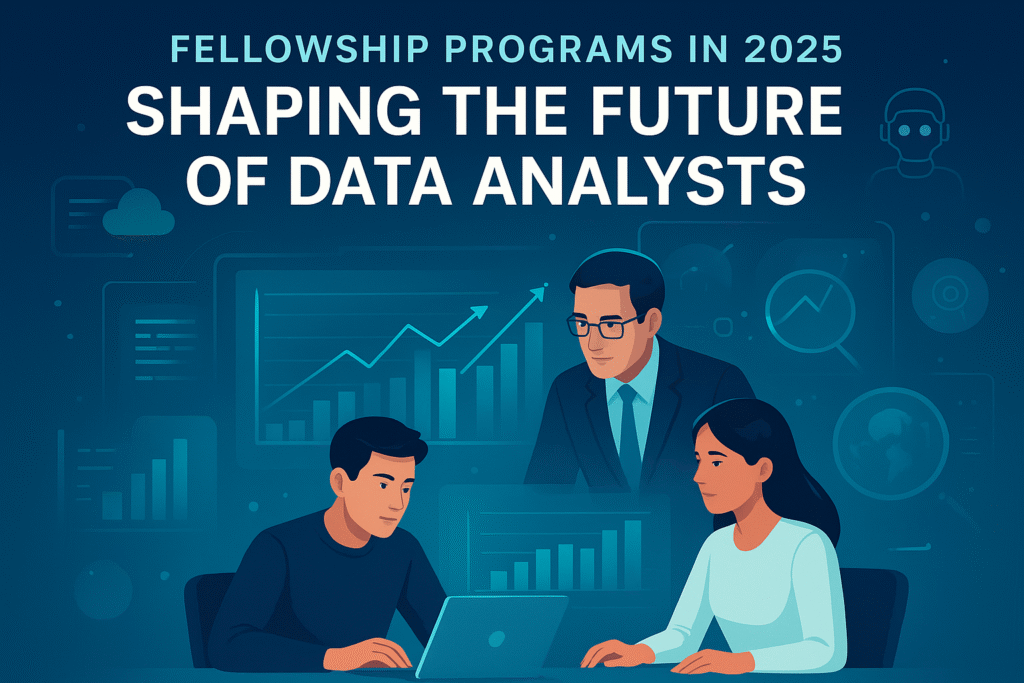
Here’s how these programs are shaping the future of data analytics careers in 2025:
Table of Contents
1. Beyond Theory: Hands-On Data Analysts Training
Fellowship programs focus on learning by doing. Instead of studying statistical models in theory, fellows work on:
- Live datasets
- Industry case studies
- Real business challenges
This ensures graduates don’t just understand analytics concepts—they apply them in real-world contexts.
2. Building Industry-Relevant Skills
Employers expect more than just number crunching. Fellowship programs emphasize skills that are immediately useful in careers in data analytics:
Today’s employers want versatile data analysts who can combine technical and business expertise. Fellowship programs emphasize:
- Technical Skills: Python, SQL, Tableau, Power BI, cloud platforms, machine learning basics
- Business Acumen: Industry-focused problem-solving in finance, healthcare, e-commerce, and more
- Data Storytelling: Communicating insights through effective visualization and narratives
This blend prepares fellows to thrive in diverse industries and adapt quickly to new challenges. Data-driven roles are no longer limited to analytics—fields like marketing are also evolving rapidly, as shown in our beginner’s roadmap to digital marketing.
3. Mentorship and Career Networking
A key advantage of fellowship programs is access to industry mentors. Experts guide fellows on career pathways, project development, and portfolio building. Beyond mentorship, fellows also join powerful networks of peers, alumni, and hiring partners—opening doors to internships and full-time roles.
Industry expectations
- Career roadmaps
- Building a professional portfolio
Fellows also join strong professional networks—peers, alumni, and hiring managers—that open doors to internships, job placements, and collaborations.
4. Creating Future-Ready Leaders
These programs don’t just train analysts; they build future leaders in data analytics. Participants learn to:
- Think strategically about data-driven decision-making
- Understand the business and societal impact of analytics
- Grow into leadership roles like data strategist, analytics consultant, or chief data officer
Added Value: Why Fellowships Stand Out in 2025
To further highlight their uniqueness, fellowships also offer:
- Structured Learning Paths – covering beginner to advanced concepts, ensuring accessibility for all learners.
- Capstone Projects – showcasing real-world problem-solving ability to employers.
- Global Recognition – as companies worldwide increasingly acknowledge the value of fellowship-trained analysts.
Success Stories from Fellowship Graduates
Many fellowship-trained analysts have gone on to build impressive careers in global firms. For example:
- Analysts who started with basic SQL skills now lead predictive analytics teams in banking.
- Graduates working on fellowship capstone projects with healthcare datasets are now driving patient-care innovations.
- Fellows who specialized in retail analytics are helping e-commerce giants design smarter recommendation engines.
These real-world transitions show how fellowships transform learning into tangible career outcomes.
Challenges Data Analysts Face—and How Fellowships Solve Them
The path to becoming a skilled data analyst isn’t always smooth. Common challenges include:
- Information Overload: Too many tools and technologies to choose from.
- Practical Gaps: Knowing theory but lacking real-world application.
- Career Navigation: Struggling to stand out in a competitive job market.
Fellowship programs address these challenges by offering structured pathways, curated tools, and career mentorship that streamline learning and accelerate professional growth.
The Future of Data Analytics Careers in 2025
As businesses adopt AI, automation, and predictive analytics, the demand for skilled data analysts will only rise. Fellowship programs provide not just technical training but holistic career development—equipping individuals with adaptability, problem-solving, and leadership skills.
For aspiring analysts, joining a fellowship is more than just education—it’s a career accelerator. By combining mentorship, live projects, and industry-focused training, these programs prepare professionals to lead the next wave of transformation in the global data economy.